Applications such as conveyor systems, rolling mills, crushers, and large compressors benefit from smoother operation and optimized output. The ability to adjust speed according to load demand enhances overall system flexibility.
MV VFDs are also known for their soft-start capability. Unlike traditional direct-on-line starting methods that create high mechanical and electrical stress, MV VFDs allow gradual ramp-up of motor speed. This reduces wear and tear, lowers maintenance costs, and extends equipment lifespan.
In conclusion, Medium Voltage Variable Frequency Drives are essential solutions for modern industrial motor control. They provide energy efficiency, enhanced reliability, superior process control, and long-term cost savings. By integrating advanced technology with robust engineering, MV VFDs play a critical role in optimizing industrial operations while supporting sustainable and efficient energy utilization.
Medium Voltage Variable Frequency Drives (MV VFDs)
Medium Voltage Variable Frequency Drives (MV VFDs) are advanced motor control systems designed to regulate the speed, torque, and overall performance of medium voltage motors typically ranging from 3.3 kV to 13.8 kV. These drives are widely used in heavy industrial applications where large motors are required to operate efficiently and with precise control.
An MV VFD works by converting fixed-frequency electrical power into a variable frequency output, allowing operators to adjust motor speed according to process requirements. MV VFDs provide smooth acceleration and deceleration, minimizing mechanical stress and reducing inrush current.
One of the key advantages of MV VFDs is significant energy savings. In applications involving pumps, fans, and compressors, power consumption is directly related to motor speed. This leads to lower operational costs and improved system efficiency.
MV VFD systems are engineered with advanced power electronics and intelligent control algorithms. They incorporate multi-level inverter technology, ensuring lower harmonic distortion and improved power quality.
Reliability and safety are major design considerations in MV VFDs. These drives feature robust insulation systems, advanced cooling mechanisms, and protective functions such as overcurrent, overvoltage, short circuit, and thermal protection. Modern MV VFDs are equipped with digital control panels and remote monitoring capabilities, enabling real-time performance tracking and predictive maintenance. This ensures minimal downtime and enhanced operational continuity.
Another important benefit of MV VFDs is improved process control. By precisely regulating motor speed and torque, industries can maintain consistent production quality.
Salient Features of Medium Voltage Variable Frequency Drives (MV VFDs):
- Designed for medium voltage applications ranging from 3.3kV to 13.8kV.
- Precise motor speed and torque control for improved process performance.
- Significant energy savings in pumps, fans, compressors and heavy-duty systems.
- Soft starting and smooth acceleration to reduce mechanical stress.
- Reduced inrush current and minimized voltage dips.
- Advanced multi-level inverter technology for low harmonic distortion.
- Improved power factor and enhanced power quality.
- Built-in protection: Overcurrent, Overvoltage, Short Circuit & Thermal protection.
- Intelligent digital control panel with real-time monitoring.
- Remote diagnostics and predictive maintenance capability.
- High reliability with robust insulation and cooling systems.
- Compact design with easy installation and low maintenance.
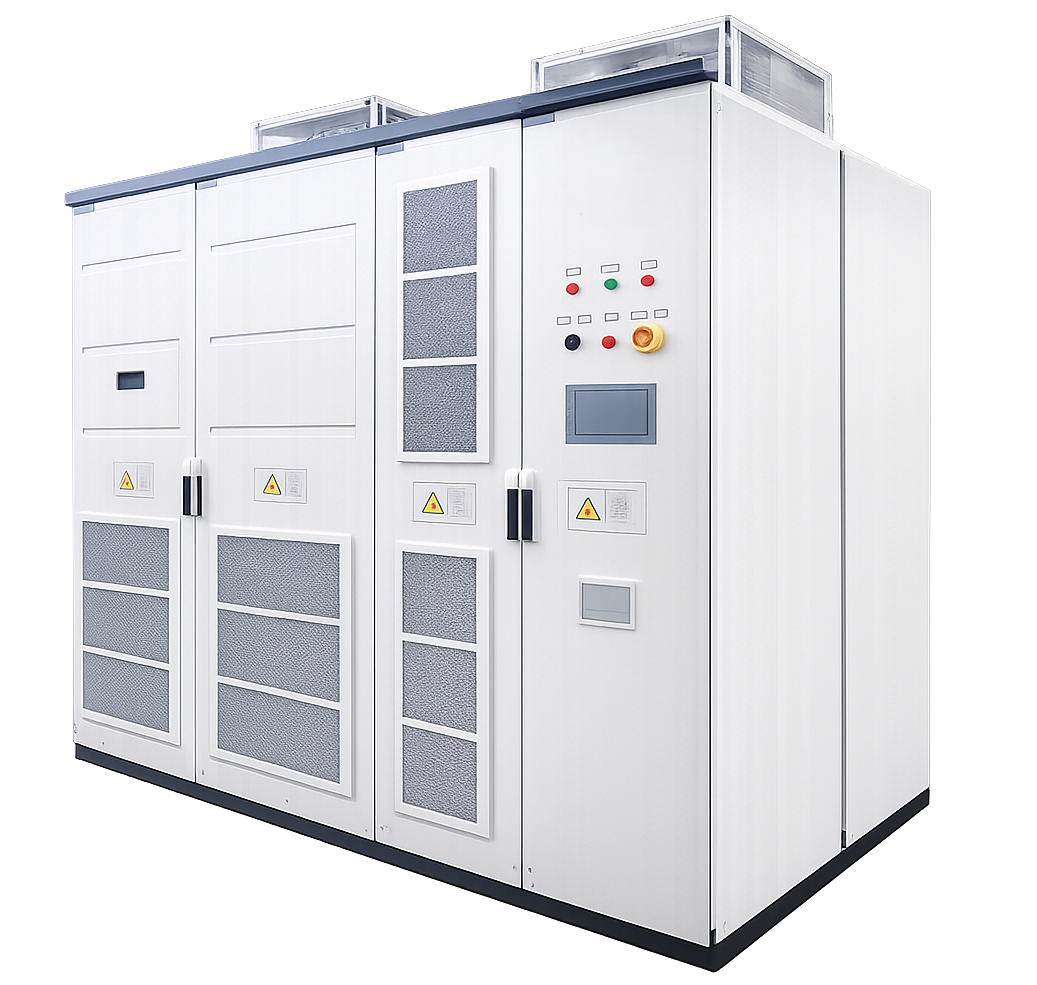
Applications & Benefits of MV VFD
Advanced Medium Voltage Drive Solutions for High Power Industrial Applications
Significant Energy Savings
By matching motor speed with actual load requirements, MV VFD significantly reduces electricity consumption, especially in centrifugal loads like pumps and fans.
Reduced Equipment Wear
Smooth soft starting and stopping minimizes mechanical stress, extending the life of motors, gears, couplings, and connected machinery.
Improved Process Control
Enables precise control of pressure, flow, torque, and speed for optimized and efficient industrial operations.
Reduced Current Draw
Medium voltage operation reduces line current compared to low voltage systems, allowing smaller cable sizes and minimizing power losses.
Operational Flexibility
Supports automatic, fast, or user-defined speed adjustments to adapt quickly to changing process conditions.